
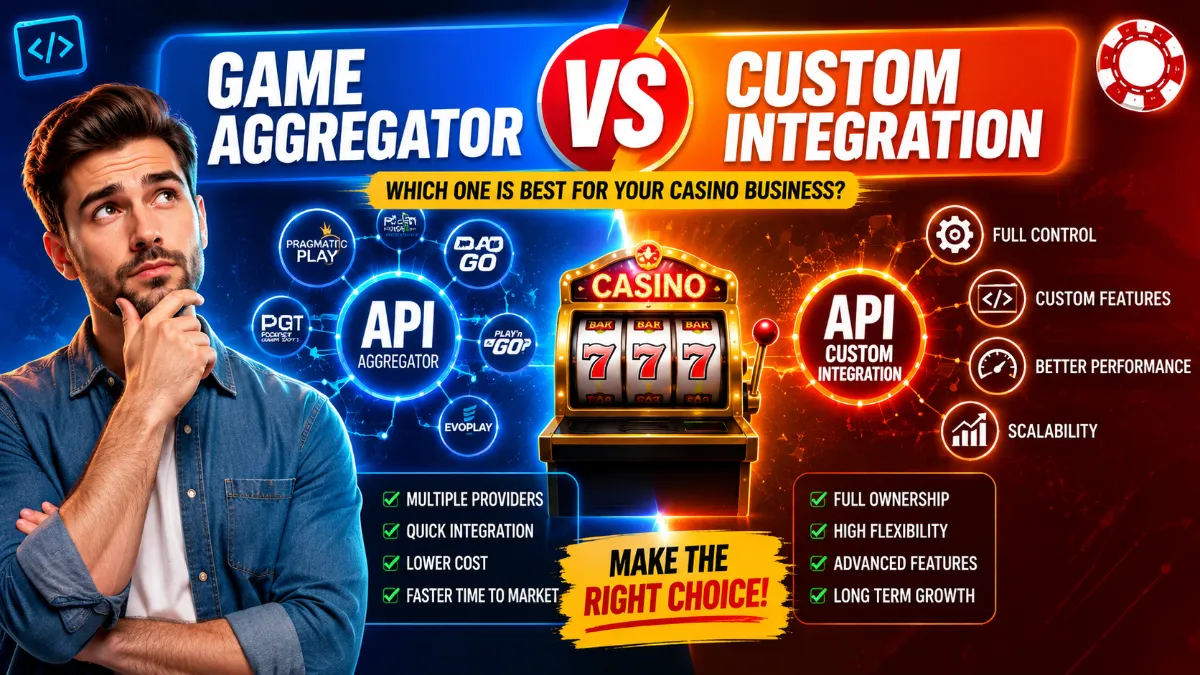
Custom Game Integration vs Game Aggregator APIs for iGaming Platforms
Every iGaming operator eventually hits the same fork in the road: how do you actually get games onto your platform?
That single decision quietly shapes almost everything that follows - how fast you can launch, how much engineering time you’ll burn, what your operating costs look like year after year, and how competitive your lobby feels next to the operators who chose the other path. It influences player retention, marketing flexibility, compliance risk, and even the kind of commercial conversations you can have with studios down the line. In short, it is one of those architectural choices that looks technical on the surface but is deeply strategic underneath.
There are two main ways to do it. One is custom game integration: you build direct, one-to-one connections with individual studios and providers. The other is working with a game aggregator - a single platform that has already hooked up hundreds or thousands of games from many providers and hands them to you through one unified API.
Neither option is automatically better. The right call depends on your launch timeline, the size of your engineering team, the markets you’re targeting, your licensing footprint, and how much you need your content library to stand out. Some operators lean heavily one way. Others mix both. This guide walks through both models in plain language so CTOs and product managers can make a decision they can actually defend later - to their board, to their investors, or simply to their own future selves when the next market opens up.
What Custom Game Integration Really Means
Custom integration is exactly what it sounds like. Your platform team builds and maintains a direct API connection to each game provider. Want games from five different studios? Your engineers integrate five separate APIs. Each one comes with its own authentication method, session handling, wallet callbacks, error styles, and certification checklist. There is no shared standard. Every provider has evolved its own way of doing things, and your team has to learn and support all of them.
This is how most in-house casino platforms started before aggregators became common. Some operators still deliberately choose it today, especially when a particular provider relationship matters more than having the widest possible catalog. For them, the extra work is the price of control and exclusivity.
Here’s how the process usually unfolds for every new provider:
- Commercial negotiation - revenue share, minimum guarantees, exclusivity terms, marketing support, and sometimes bonus funding arrangements.
- Technical onboarding - reading the documentation (which varies wildly in quality), getting sandbox access, receiving credentials, and understanding the provider’s preferred integration pattern.
- Wallet integration - wiring the provider’s bet, win, and rollback events into your real-money or PAM wallet so that every transaction is correctly recorded and reconciled.
- Session and authentication - building launch URLs, handling tokens, single sign-on flows, and session validation so players move smoothly from your lobby into the game.
- Certification and compliance testing - confirming RNG certificates, implementing local rules such as UK reality checks or loss limits, and making sure responsible gambling hooks fire correctly.
- QA across devices, browsers, and network conditions - catching edge cases that only appear on certain mobile browsers or under poor connectivity.
- Go-live and ongoing maintenance - providers keep adding games, retiring old API versions, changing specs, and occasionally introducing breaking changes. Your team stays on the hook for all of it.
Every one of those steps repeats for every new studio you add. There is no shortcut. The more providers you want, the more parallel workstreams you create, and the more institutional knowledge your team has to retain.

What a Game Aggregator API Actually Does
A game aggregator sits between your platform and the providers. The aggregator has already done the hard work of integrating dozens or hundreds of studios - slots, live dealer, table games, RNG titles, and increasingly sports or virtual sports content - and exposes that whole catalog through one standardized API.
Instead of building five integrations to reach five providers, you build one integration to the aggregator and suddenly have access to far more than five studios. The aggregator becomes your single point of contact for content. New games appear in their catalog and can be enabled on your side with configuration rather than code. Provider outages or API changes are largely absorbed and normalized before they reach you.
What the aggregator typically takes off your plate:
- A single game launch and session API that works across every connected provider
- Centralized wallet handling (single-wallet or seamless architectures)
- Provider onboarding and day-to-day lifecycle management (new games, deprecated titles, temporary outages)
- Jurisdictional filtering so only certified games appear in a given market
- Reporting and reconciliation across the entire catalog in a consistent format
- Standardized free-round and bonus APIs that work the same way regardless of which studio created the game
- Ongoing compliance updates when regulations change in the markets you operate in
Your engineering effort shifts from “integrate N providers” to “integrate one aggregator, then decide which games and providers to switch on.” The difference in operational load is significant, especially once your catalog grows beyond a handful of studios.
Side-by-Side: The Real Differences
| SL No | Factor | Custom Integration | Game Aggregator |
|---|---|---|---|
| 1 | Initial integration effort | High - one full build per provider | Low - one build total |
| 2 | Time to market | Slower, gets worse as the catalog grows | Faster, mostly independent of catalog size |
| 3 | Content breadth | Only what you actively integrate | Hundreds to thousands of titles from day one |
| 4 | Ongoing maintenance | Your team owns every provider relationship | Aggregator absorbs most provider-side changes |
| 5 | Commercial terms | Direct deals, potentially better margins | Aggregator takes a cut; less leverage per title |
| 6 | Differentiation | High - exclusives and first-to-market possible | Lower - many competitors use the same catalog |
| 7 | Engineering overhead | Keeps growing with every new provider | Front-loaded, then largely stable |
| 8 | Compliance handling | You own it provider by provider and market by market | Often baked into the aggregator’s layer |
| 9 | Control over UX/launch flow | Full control | Limited by the aggregator’s API design |
Looking at the table, the trade-offs become clearer. Custom work buys you control and potential commercial upside at the cost of speed and ongoing effort. Aggregation buys you speed and operational simplicity at the cost of some differentiation and a slice of margin.
Why Some Operators Still Choose Custom Integration
1. Content exclusivity and real differentiation
If your strategy depends on offering games almost nobody else has - an exclusive branded slot, a first-look title from a rising studio, or something you developed in-house - a direct relationship is usually the only realistic route. Aggregators are built for scale and standardization, not for cutting one-off exclusivity deals on your behalf. When a studio wants to test a new concept with a limited number of operators, they almost always go direct.
2. Better commercial control
Direct deals mean you negotiate revenue share without an intermediary’s margin sitting in the middle. For high-volume operators that difference adds up over time. You also control minimum guarantees, co-marketing budgets, and bonus funding arrangements yourself. You can structure deals that reward performance or lock in preferential terms for a period. With an aggregator, those conversations happen at one remove.
3. Tighter technical control
Your engineers see every request and response, every error state, every session detail. That matters if your platform has unusual requirements - a non-standard wallet model, a proprietary bonus engine that needs deep hooks into game rounds, or strict latency needs for live betting where every millisecond counts. Aggregators smooth over differences between providers; sometimes you need those differences to remain visible.
4. Stronger strategic relationships
Some operators deliberately build direct integrations to deepen ties with a studio - joint marketing campaigns, co-development of new titles, or preferential access to new releases before they hit the aggregator platforms. Those relationships can become a competitive advantage that is hard for pure aggregator operators to match.
The trade-offs are real and cumulative.
Custom work is engineering-heavy and does not scale cleanly. Every new provider is a full project: new documentation, new certification cycle, new production edge cases, and new monitoring requirements. You need a dedicated integrations function that stays active year after year, not a one-and-done project. Knowledge walks out the door when engineers leave. Documentation becomes outdated. Edge cases accumulate. For operators who need to launch quickly with a broad catalog, this is usually the slowest and most expensive route in the short to medium term.

Why Game Aggregators Win for Many Operators
1. Speed to market
This is the biggest practical advantage. One well-documented API integration can put hundreds of already-certified, jurisdiction-ready games live in weeks. Reaching the same catalog size through pure custom work often takes many months or longer, especially if providers are busy or certification queues are long. When you’re racing to launch or expanding into a new market under regulatory deadlines, that speed can decide whether you capture early market share or arrive after the field is already crowded.
2. Instant catalog breadth
New operators rarely have the leverage to lock in favorable direct deals with top studios. Aggregators already have those relationships, so even a freshly licensed operator gets access to major content without first building a long commercial track record. Players expect a certain volume and variety of games from day one. An aggregator makes that expectation realistic rather than aspirational.
3. Much lower ongoing engineering load
API version changes, new certification rules, deprecated endpoints, and occasional breaking changes become the aggregator’s problem to absorb and normalize. You need a smaller integrations team, which frees engineers to work on things that actually differentiate the product: loyalty systems, personalization engines, front-end experience, responsible gambling tools, or proprietary features competitors do not have. The opportunity cost of keeping a large integrations team is real.
4. Built-in multi-jurisdiction compliance
Good aggregators keep certifications current across multiple regulated markets and can automatically filter so players only see games certified for their license. If you run platforms under more than one license (Malta and Curaçao, for example, or later expansions into new regulated territories), this removes a large compliance headache. Tracking provider-by-provider certification status manually becomes impractical once the number of markets grows.
5. Cleaner reconciliation and reporting
With dozens of direct integrations you end up reconciling GGR, bonus liability, and wallet transactions across completely different reporting formats, time zones, and data structures. Aggregators usually standardize those reports, which makes life easier for finance, trading, and business intelligence teams. Fewer reconciliation errors mean fewer disputes and cleaner monthly closes.
The downsides are equally practical.
Differentiation is the obvious one. If your competitors use the same aggregator, you are mostly offering the same games. Players notice when lobbies look interchangeable. Commercially, the aggregator’s margin sits between you and the provider, which can reduce your effective share compared with a strong direct deal. For smaller or mid-sized operators without the volume to negotiate great direct terms, this is often neutral or even better than what they could achieve alone. You are also somewhat limited by the aggregator’s API design and roadmap. Non-standard requirements can be harder or slower to accommodate. Exit terms and migration paths vary, so lock-in risk needs careful contract review.
How to Decide Which Model Fits
There is rarely one perfect answer, but a few practical questions usually point clearly one way or the other.
Go custom if:
- Your product strategy is built around exclusive or proprietary content that competitors cannot easily copy
- You already have an engineering team with capacity and appetite for ongoing provider maintenance
- You are negotiating high-volume deals where direct terms meaningfully improve margins
- Your platform has non-standard architecture that off-the-shelf aggregator APIs struggle with
- Speed to market is less important than long-term content strategy and commercial control
Choose an aggregator if:
- You need to launch quickly, especially in a competitive or newly regulated jurisdiction
- You are a newer operator without the commercial weight for strong direct deals
- Your engineering team is lean and better spent on player experience than integrations maintenance
- You operate across multiple licenses and want compliance filtering handled centrally
- Catalog breadth and variety matter more than exclusivity for your target audience
The hybrid approach most mature operators eventually adopt
In practice, many established operators run both models at once. The aggregator supplies the broad, always-available catalog - the hundreds of titles players expect to see when they open the lobby. A handful of custom integrations are reserved for strategically important content: an exclusive branded game, a proprietary title developed in-house or with a studio partner, or a first-look deal with a rising studio that has not yet reached the aggregator platforms.
This hybrid captures the speed and breadth of aggregation while still leaving room for real differentiation where it counts. Modern PAM systems are usually designed to support exactly this architecture. Both the aggregator connection and direct provider connections plug into the same wallet and session layer. The choice is no longer binary at the platform architecture level; it is only a content-sourcing decision. Operators can start pure aggregator and later add direct connections, or begin with a few strategic direct deals and layer an aggregator underneath for breadth. Flexibility at the PAM level makes both paths viable.
Technical Points CTOs Should Pressure-Test
How standardized is the aggregator’s API really?
Some aggregators still pass through a lot of provider-specific quirks in error codes, session behavior, or bonus handling. That undercuts the whole “integrate once” promise. Ask for detailed documentation, sample payloads, and a proper sandbox environment before you commit. Run real game launches and wallet flows yourself rather than relying only on sales presentations.
Wallet architecture compatibility
Single-wallet (seamless) versus transfer-based models affect which aggregators and providers you can realistically work with. Seamless usually feels better for players because there is no intermediate transfer step, but it requires real-time balance calls that match your wallet’s transaction model and rollback handling. Transfer models are simpler but introduce extra steps that can affect player experience and reconciliation.
Latency and performance
For ordinary slots, a 50–100 ms difference is rarely noticeable to players. For live dealer or live betting, latency and connection stability matter a lot. Test this thoroughly in sandbox under realistic network conditions before locking anything in. Ask about the aggregator’s infrastructure geography and how it routes traffic for different regions.
Certification footprint and multi-jurisdiction support
If you plan to expand across regulated markets, check exactly which jurisdictions the aggregator (or each individual provider in a custom model) is already certified for, and how quickly they have historically added new ones. Strong UK and Malta coverage with no clear roadmap for emerging markets may not fit a global expansion plan. Ask for current certification lists and historical timelines for adding new jurisdictions.
Vendor lock-in risk
Exit terms vary widely. Some aggregators make it relatively straightforward to migrate providers or switch aggregators later; others create real technical and commercial friction through data formats, proprietary IDs, or long notice periods. Scrutinize this at contract stage, not after go-live. Understand what happens to historical reporting data and how player sessions would be handled during a transition.
Cost Reality Check
Exact numbers are always deal-specific and depend on volume, markets, and negotiation strength, but the patterns are consistent across the industry:
- Custom integration usually means higher upfront engineering cost per provider, longer time to first revenue from that content, and ongoing maintenance headcount. The potential upside is better long-term commercial terms if you have enough volume to negotiate strong revenue shares and marketing support.
- Aggregator integration usually means lower upfront engineering cost, faster time-to-revenue, and a smaller ongoing integrations team. The trade-off is an ongoing aggregator margin built into the commercial structure. That margin is often justified by the reduced headcount and faster catalog growth.
For most operators below a certain scale, the engineering time and headcount saved by not maintaining dozens of direct integrations outweighs the marginal commercial benefit of pure direct deals. Larger operators with dedicated integrations teams, high game volume, and strong commercial leverage are more likely to find custom work commercially attractive, at least for their highest-performing content. Many end up in the hybrid middle ground precisely because the cost-benefit calculation is different for different parts of the catalog.

Bottom Line
The choice between custom integration and a game aggregator is not really about which technology is superior. Both are proven and used by successful operators across the industry. It is a strategic decision about where you want to spend engineering effort and where you want to spend your differentiation budget.
If speed, breadth, and lower ongoing engineering load matter most right now, an aggregator is usually the right foundation. If your competitive edge depends on exclusive content or you have the scale to negotiate clearly superior direct terms, custom integration - or a hybrid that layers direct deals on top of an aggregator base - is worth the extra investment.
For most operators launching or scaling today, the practical path looks like this: start with a solid aggregator integration so you can get to market quickly with a broad, certified catalog. Then, as the platform matures and specific commercial or strategic opportunities appear, selectively add custom, direct relationships for the content that truly differentiates you. That combination gives you the best balance of speed, cost, operational simplicity, and long-term flexibility. Architecture decisions made early should leave room for this evolution rather than locking you into one model forever.
Frequently Asked Questions
Can I switch from custom integration to an aggregator later without rebuilding the platform?
In most well-designed PAM systems, yes. As long as your wallet and session layer is not tightly coupled to any single provider’s API structure, adding an aggregator connection next to existing custom integrations is normally a parallel project rather than a full replacement. The key is keeping the content layer loosely coupled from the start.
Do aggregators support live dealer and table games, or only slots?
Most major aggregators now support live dealer, RNG table games, and slots through the same unified API. The depth of live-dealer studio partnerships still varies a lot between aggregators, so check this carefully if live content is a priority for your brand. Some aggregators have stronger relationships with particular live studios than others.
How long does a typical aggregator integration take compared with custom work?
An aggregator integration commonly takes a few weeks from technical kickoff to a live, certified catalog, depending on jurisdiction and certification requirements. Covering the same breadth of content through pure custom integration - dozens of individual providers - can easily take many months to a year or more when done sequentially, especially if provider onboarding queues or certification processes create delays.
Does using an aggregator limit the jurisdictions I can operate in?
Not by itself, but each aggregator has its own certification footprint. Confirm that the aggregator’s current certifications match your licensing plans, especially for less common or newly regulated jurisdictions. Ask about their process and historical speed for adding new markets.
Is a hybrid model more expensive to maintain than choosing one approach exclusively?
It usually requires a small dedicated integrations function to manage the custom connections, but far less than running a fully custom approach across the entire catalog. Most operators who adopt the hybrid model find the extra cost justified by the differentiation and commercial upside the exclusive or strategic content delivers. The aggregator continues to handle the bulk of the catalog with relatively stable overhead.
