
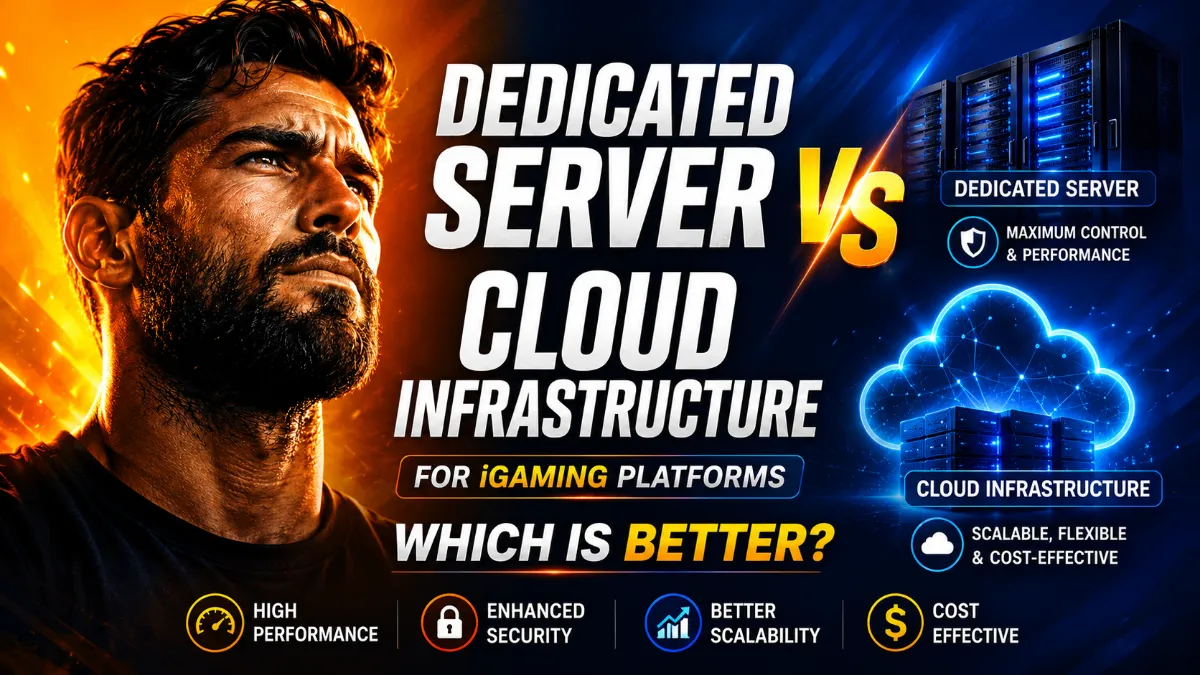
Dedicated Server vs Cloud Infrastructure for iGaming Platforms Which Is Better
Every iGaming CTO eventually hits the same uncomfortable fork in the road.
You’ve built the platform. The games are certified. The sportsbook odds engine is humming. Marketing is already talking about the next big market launch. And then someone - usually a regulator, a compliance officer, or your own CFO - asks the question that changes everything downstream:
Where exactly is this thing going to live?
Do you run your casino or sportsbook on dedicated, physically owned (or leased) servers, or do you build on cloud services like AWS or Azure?
It sounds like a pure infrastructure decision. In most industries it would be. In iGaming it is not. The choice shapes latency during peak betting windows, how fast you can enter a newly regulated market, the size of your DevOps team, your disaster-recovery posture, and - over a three-to-five-year horizon - your true total cost of ownership. Get it wrong and you’re not just looking at higher AWS bills. You’re looking at licensing delays, failed regulator audits, or a platform that buckles the moment the Champions League final kicks off.
This is not another generic “cloud vs on-prem” comparison written for SaaS startups. iGaming platforms carry constraints that almost no standard infrastructure guide ever addresses: licensing bodies that care deeply about data residency, RNG certification requirements that still reference physical or tightly controlled logical environments, PCI-DSS obligations for payment flows, and traffic patterns that can jump 10x in minutes when a major sporting event starts.
So let’s walk through the decision the way a real CTO has to - with the regulatory, operational, and commercial realities on the table.
Why This Decision Is Strategic, Not Just an IT Ticket
In most companies, hosting is treated as a cost-center problem that gets handed to engineering and forgotten. In iGaming it sits much closer to product and compliance.
Licensing authorities actually care where your servers sit. The Malta Gaming Authority, Curaçao eGaming, the UK Gambling Commission, and various US state regulators (New Jersey DGE, Pennsylvania Gaming Control Board, and others) all have rules - some strict, some still evolving - around data residency, server auditability, and the environments in which RNGs must be certified. A regulator who cannot clearly see and audit the infrastructure is a regulator who slows down your license or attaches uncomfortable conditions to it.
Traffic is violently event-driven. A pure sportsbook can run at relatively modest baseline load most of the week and then explode during a handful of marquee fixtures. A slots-heavy casino is steadier but still spikes hard around promotions, jackpot drops, and big tournament weekends. That kind of pattern punishes poorly designed elasticity and rewards predictable, high-capacity environments.
Downtime is not an abstract availability metric. Every minute a sportsbook is unavailable during a live match is lost handle, frustrated players, and potential regulatory questions about fair-play continuity. Reputation damage in this industry travels fast.
Payment processing sits under PCI-DSS (and increasingly under additional crypto and e-wallet scrutiny). Card data, wallet integrations, and settlement rails all need an environment that can survive third-party security audits without drama.
Against that backdrop, the two models need clear definition before any comparison makes sense.
What Dedicated Server Hosting Actually Means for Casino Platforms
A dedicated server is a physical machine - or a fleet of them - that runs exclusively for your platform. No other tenant shares the underlying hardware. You (or your managed hosting partner) control the operating system, the network configuration, the storage layout, and in many cases the physical location of the data center.
In practice, iGaming operators usually land in one of three flavors:
- Self-owned data center or classic colocation. You buy (or long-term lease) the hardware and rent rack space, power, and cooling. Maximum control, maximum capital expenditure, maximum operational burden.
- Managed dedicated hosting. A specialist provider owns and maintains the metal, but it is allocated solely to you. Jurisdiction-specific placement is a common request - operators licensed in Malta or Curaçao often want explicit guarantees about where the servers physically sit.
- Bare-metal-as-a-service. Providers such as OVHcloud, Hetzner, or a handful of specialized iGaming hosts will provision dedicated hardware on demand. You get physical isolation with some of the provisioning speed of the cloud.
Dedicated servers became the historical default for casino platforms for a simple reason: RNG certification labs (GLI, eCOGRA, and others) have long audited physical hardware and network isolation as part of certifying game fairness. Many regulators remain more comfortable examining a known physical environment than an abstracted, multi-tenant cloud tenancy. That preference is slowly softening, but it has not disappeared.
What Cloud Infrastructure Looks Like in Practice
Cloud infrastructure - most commonly AWS, Microsoft Azure, or Google Cloud - gives you virtualized compute, storage, and networking that you provision from a shared pool of hardware owned and operated by the provider. You never see or touch the physical machine. Everything happens through APIs, consoles, and infrastructure-as-code.
For an iGaming platform that typically means:
- AWS: EC2 for compute, RDS or Aurora for databases, S3 for static assets and long-term compliance archives, Shield and WAF for DDoS and application protection. Some operators lean on regionally isolated setups that approximate the isolation of older dedicated environments.
- Azure: The equivalent stack (Virtual Machines, Azure SQL, Blob Storage, Azure Front Door). European operators sometimes prefer it because of Microsoft’s enterprise compliance posture and dense EU data-center footprint.
- Google Cloud: Still less common for core gaming workloads, but attractive when heavy analytics and BigQuery sit close to the operational systems.
Cloud providers have also introduced dedicated instances and dedicated hosts (AWS Dedicated Hosts, Azure Dedicated Host). These sit in a useful middle ground: physically isolated hardware that is still managed through cloud tooling and billed more flexibly than traditional dedicated contracts. That hybrid category is increasingly relevant and deserves its own weight in any serious evaluation.

Head-to-Head: The Factors That Actually Matter to a Casino CTO
1. Performance and Latency
Dedicated servers still win on raw, predictable performance. Because nothing else is sharing your CPU cycles, memory bandwidth, or network I/O, a well-specified dedicated box delivers consistent latency. That consistency matters for live-dealer streaming, real-time RNG calls, and in-play sportsbook odds updates. Even 50–100 ms of jitter is noticeable to players and can affect the perceived fairness of bet settlement.
Cloud has closed a large part of the gap. Modern providers offer bare-metal instances, enhanced networking, and placement groups that deliver near-dedicated performance. “Noisy neighbor” effects - another tenant’s workload degrading yours - are rarer than they used to be on standard instances, but they have not been eliminated entirely.
If your platform includes live dealer games or high-frequency in-play betting, this factor should push you toward dedicated hardware or cloud dedicated-host options. For a straightforward slots and table-games casino without live streaming, standard cloud compute is usually more than adequate.
2. Scalability and Elasticity
This is where cloud shines brightest. When a major football final starts, traffic can multiply several times over in a matter of minutes. Cloud lets you auto-scale compute, database read replicas, and caching layers in response to real demand. You pay for what you use (within the limits of your architecture) and scale back when the event ends.
Dedicated infrastructure requires you to size for the peak in advance. That means either over-provisioning (and paying for idle capacity most of the week) or accepting that you will hit a hard ceiling during the biggest events. Some operators mitigate this with hybrid designs - core systems on dedicated metal, overflow capacity in the cloud - but pure dedicated environments are less elastic by nature.
Sportsbooks feel this difference more acutely than pure casino platforms. The traffic curve of a sportsbook is simply more extreme.
3. Data Residency, Licensing, and Regulatory Comfort
This is often the decisive factor, and it is still under-discussed in generic infrastructure conversations.
Many regulators want to know, with reasonable certainty, where player data and game logic actually reside. Some jurisdictions have explicit residency requirements. Others are more flexible but still expect clear audit trails and the ability to inspect the environment. Dedicated servers (especially when located in a known, contracted data center inside the relevant jurisdiction) make that conversation simpler.
Cloud regions can satisfy many of the same requirements, and the major providers have invested heavily in compliance certifications and regional isolation. The practical difference is often one of perception and audit friction rather than absolute technical impossibility. A regulator who has audited physical dedicated environments for fifteen years may still ask more questions about a pure multi-tenant cloud setup than about a dedicated host or a carefully isolated private cloud.
RNG certification adds another layer. While labs have adapted to cloud and virtualized environments, some certifications remain more straightforward - and sometimes cheaper and faster - when the hardware is physical and fully under the operator’s control.
4. Security, Compliance, and Auditability
Both models can be made highly secure. Both models can fail security if the operator is careless.
Dedicated environments give you complete control over the attack surface and the ability to implement custom network segmentation, physical access controls, and monitoring that some security teams prefer. Cloud environments give you a much richer set of managed security services (identity management, logging, threat detection, DDoS protection) and the benefit of the provider’s continuous security investment.
PCI-DSS is achievable in both. The audit effort and the shared-responsibility model differ. In the cloud you must be rigorous about configuration and access controls because the provider is responsible for the underlying infrastructure. On dedicated metal you own more of the stack and therefore more of the risk if something is misconfigured.
Crypto payment rails and e-wallet integrations introduce additional considerations, but those are largely independent of the dedicated-versus-cloud choice as long as the environment can pass the relevant security assessments.
5. Operational Overhead and Team Composition
Dedicated infrastructure almost always demands a larger or more specialized operations team. Someone has to handle hardware failures, firmware updates, network configuration, capacity planning, and physical data-center coordination. Even with a managed dedicated provider, the residual operational load is higher than with a well-architected cloud setup.
Cloud shifts a large portion of that burden to the provider and to infrastructure-as-code practices. The team still needs strong cloud expertise, cost-management discipline, and security hygiene, but the day-to-day hardware babysitting disappears. Many modern iGaming companies deliberately keep their core platform engineering teams smaller and more product-focused by leaning on cloud.
The trade-off appears in the budget: cloud costs can become unpredictable if not tightly governed, while dedicated costs are more fixed but include higher people costs and capital (or long-term lease) commitments.
6. Total Cost of Ownership Over Three to Five Years
This is where many conversations get emotional and where the spreadsheet work becomes essential.
Dedicated infrastructure front-loads capital or long-term contractual spend. You pay for capacity whether you use it or not. Over a multi-year period, if your traffic is relatively predictable and you can keep utilization high, the unit economics can look attractive. Hardware refresh cycles, power, cooling, and staffing must be included honestly.
Cloud looks cheaper at the beginning and during periods of lower load. It becomes expensive when traffic is high and sustained, or when the architecture is not cost-optimized (oversized instances, inefficient data transfer, poorly managed storage). The major providers have made significant progress on committed-use discounts, savings plans, and reserved capacity, but the discipline required to keep costs under control is real.
Hybrid approaches - dedicated for core latency-sensitive and regulated workloads, cloud for analytics, overflow, content delivery, and non-critical services - often produce the most defensible long-term cost profile. They also give the organization an escape hatch if regulatory or commercial conditions change.
7. Time to Market and Geographic Expansion
Cloud wins on speed for most new market entries. Standing up a new regional presence, spinning up the necessary compliance logging, and attaching the right network controls can be done in days or weeks rather than months. Dedicated infrastructure still requires hardware procurement, shipping, installation, and configuration - even with responsive bare-metal providers.
For operators who need to move quickly into newly regulated US states or emerging European markets, that speed difference is material. For operators whose primary markets are stable and whose licensing footprint is already established, the advantage is less decisive.

The Hybrid Reality Most Serious Operators Are Moving Toward
Pure dedicated and pure public cloud are no longer the only options, and for many iGaming companies they are no longer the smartest ones.
A growing number of platforms run the latency-sensitive and heavily regulated core (live dealer video, RNG services, in-play odds engines, payment tokenization) on dedicated or dedicated-host infrastructure, while placing content delivery, player analytics, marketing systems, non-critical microservices, and overflow capacity in the public cloud. Some keep a private cloud or tightly controlled VPC that satisfies the most demanding regulators while still using cloud services for everything else.
This hybrid model is more complex to design and operate, but it lets the organization optimize each workload for its actual constraints instead of forcing a single answer onto every problem.

How to Make the Decision Defensible to the Board
A board does not want a technology lecture. It wants a clear recommendation tied to risk, cost, and commercial ambition.
Start with the non-negotiables: which licenses do you hold or intend to hold, and what do those regulators currently expect regarding data residency and auditability? Map those requirements against the available options in each target jurisdiction.
Next, model the traffic. Use real historical data from your biggest events. Stress-test both architectures against those peaks. Include the cost of failed bets and player churn if the platform degrades.
Then run a multi-year TCO that includes people, not just infrastructure. Be honest about the size and seniority of the team each model requires.
Finally, decide how much optionality you need. If the company plans aggressive geographic expansion or expects regulatory environments to keep shifting, bias toward flexibility (cloud or hybrid). If the footprint is stable and latency is the dominant constraint, dedicated or dedicated-host options may be the cleaner long-term choice.
Closing Thought
There is no universal winner. There is only the architecture that best matches your regulatory map, your product mix (live dealer and in-play versus pure slots), your growth plans, and your tolerance for operational complexity.
The operators who get this decision right treat it as a product and compliance decision that happens to involve infrastructure, rather than an infrastructure decision that happens to affect the product. They revisit the choice periodically as both the technology and the regulatory landscape continue to move. And they document the reasoning carefully enough that the next CTO - or the next auditor - can understand why the platform sits where it sits.
That is the real work of the iGaming CTO on this particular fork in the road: not choosing the most fashionable technology, but choosing the foundation that will still be standing, compliant, and profitable when the next Champions League final starts and the traffic arrives all at once.
Frequently Asked Questions
Dedicated vs Cloud for Casino & Sportsbook Platforms
1. Is dedicated still safer for regulators?
Yes, in many jurisdictions. Physical or dedicated-host setups still create less audit friction with Malta, Curaçao, and several US state regulators. Cloud can pass the same audits, but usually requires more explanation.
2. Can live-dealer and in-play betting run on standard cloud?
Technically yes, but latency jitter is still a risk. Most serious operators put these workloads on dedicated metal or dedicated hosts.
3. How real is the “noisy neighbour” problem?
Less common than before, but it still happens during major global events. Stress-test before relying on shared instances for critical services.
4. Does cloud reduce DevOps headcount?
Yes. Well-run cloud platforms need fewer hardware-focused people. Hybrid setups sit in the middle.
5. Is cloud cheaper over 3–5 years?
Only with strict cost control. Dedicated has higher fixed costs but more predictable economics at high utilisation. Most operators end up hybrid.
6. Do RNG labs accept cloud now?
Yes, most major labs will certify properly isolated cloud environments. Physical/dedicated setups are often still faster and cheaper to certify.
7. What about data residency?
Both models can meet the requirements. Dedicated simply makes the “where does the data sit?” conversation shorter with regulators.
8. Can I switch from cloud to dedicated later?
Yes, but it is a real migration project involving re-certification and careful cutover. Design for portability if you might need the option.
9. Are AWS/Azure Dedicated Hosts good enough?
For most operators and regulators, yes. They give physical isolation with cloud tooling and billing.
10. Biggest mistake CTOs make?
Treating this as a pure tech or cost decision instead of a product + compliance + commercial one.
11. Should a new operator start on dedicated or cloud?
Most start on cloud or managed bare-metal for speed. They move latency-sensitive and regulated workloads to dedicated later if needed.
12. How often should we revisit the decision?
Every 18–24 months, or whenever you enter a new regulated market or launch live-dealer/in-play products.
