
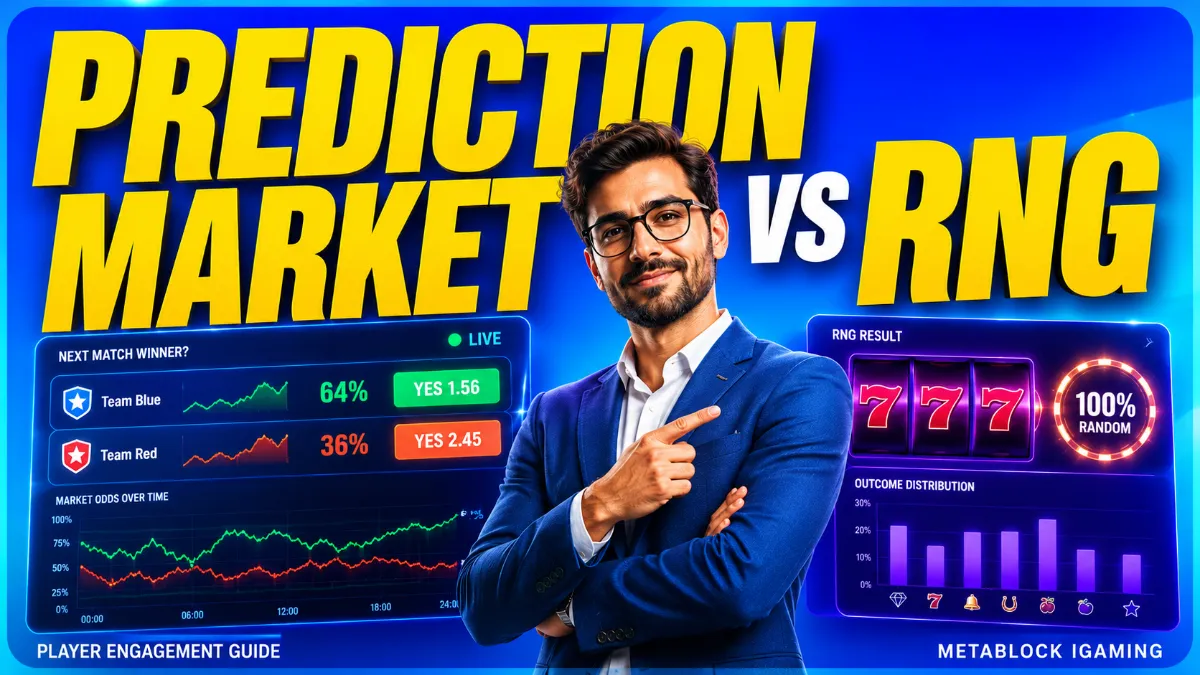
Live Prediction Market vs RNG Prediction Games Which Drives Higher Player Engagement
Prediction-based gaming used to be a nice little extra. Now it’s one of the main ways operators pull new players in and keep them coming back. As the category has grown up, though, a clear split has opened: live prediction markets on one side, RNG prediction games on the other.
Both get sold under the same “predict and win” banner, but they’re built differently, pull different kinds of players, and create completely different engagement patterns. For anyone deciding where to put development money, the difference is not cosmetic. It changes how long people stay, how they come back, what regulators think of you, and how the economics actually work over time.
This piece breaks down how both models really work, compares them on the metrics that matter, and gives a practical way to decide which one (or both) belongs on your platform.
What live prediction markets actually are
A live prediction market is where players put money on something that’s happening in the real world - a football match, an election, a price move, an esports round, even an awards show. The result is external. The platform doesn’t invent the outcome; it just lets people take positions on something that’s unfolding on its own, often in real time.
Most of these markets run on one of two models:
- Pari-mutuel or peer-to-peer pools, where the odds move based on where the money is going and the platform just takes a rake.
- Dynamic odds / market-maker style, closer to a sportsbook, where the platform (or a liquidity engine) keeps repricing as new information comes in.
Because the event is live and public, these products usually layer in real-time data, live odds movement, cash-out, and social stuff like leaderboards tied to the actual event. Players aren’t just placing a bet - they’re sitting inside a shared story with everyone else watching the same thing unfold.

What RNG prediction games are
RNG prediction games use the same “predict the outcome” language, but the result is generated inside the system by a certified random number generator. Crash games, dice, plinko-style variants, colour or number guessing, “will it go up or down” rounds - all of these sit here. The player is predicting a system outcome, not a real-world one.
The big attractions are speed and control. Rounds can be five seconds or five minutes. Volatility is tunable. From day one the operator knows the theoretical RTP and hold percentage with the same certainty they have on a slot. No external data feeds, no liquidity risk, no cancelled events, no data-latency arguments.
The architectural differences that actually matter
Before talking engagement, it’s worth being clear about what each model needs under the hood. These constraints shape both the player experience and the risk the operator carries.
| SL No. | Dimension | Live Prediction Market | RNG Prediction Game |
|---|---|---|---|
| 1 | Outcome source | Real-world / live event data | Internal RNG engine |
| 2 | Odds mechanism | Dynamic, market- or pool-driven | Fixed math model, pre-certified RTP |
| 3 | Data dependency | Third-party sports/event feeds | None |
| 4 | Round duration | Minutes to days (tied to the event) | Seconds to minutes (operator decides) |
| 5 | Regulatory classification | Often closer to betting/exchange rules | Usually treated as standard gaming/RNG |
| 6 | Liquidity risk | Present in peer-to-peer models | None - house-banked |
| 7 | Certification | Data integrity + market-making audits | RNG/RTP certification (GLI, iTech Labs etc.) |
| 8 | ceiling | High - tied to real interests | Moderate - tied to mechanics, not subject matter |
Comparing real engagement
“Engagement” gets thrown around loosely. Better to break it into the behaviours operators actually track: how often people come, how long they stay, retention, bets per session, and whether anything social or viral happens.
1. Session frequency
RNG wins this one cleanly. Because you control the round length, you can design for almost continuous play. A new round every few seconds creates a tight loop of predict → resolve → go again. That’s the same mechanic that makes crash games and quick-fire casino products sticky.
Live markets are rate-limited by the event. A football match only throws meaningful new information every few minutes at best. An election can go quiet for days. Activity clusters around scheduled events instead of being available on demand.
If the goal is daily active sessions and lots of micro-transactions, RNG has a structural edge.
2. Session length and depth
The picture flips on depth. Live markets, especially around big sporting or cultural moments, produce longer, more attentive sessions. Players don’t just place a position and leave. They watch the odds move, adjust, follow the commentary, and stay for the whole event because the outcome actually matters to them.
RNG games produce high round counts but thinner attention per round. There’s not much external information to process - people are reacting to volatility and streaks more than following a developing story.
If you want deep, emotionally invested sessions (which usually means higher stakes), live markets win on a per-session basis even if there are fewer of them.
3. Retention
This is where a lot of operator intuition goes wrong.
RNG retains through variance and habit loops - near-misses, streaks, instant feedback. Short-to-mid-term retention is strong, but it’s sensitive to how the volatility is tuned. Without any external story to explain a losing run, players can start feeling the math is “against them” and churn.
Live markets retain through relevance and identity. A player who follows a particular league, a market sector, or a set of real-world topics has a reason to come back that has nothing to do with your re-engagement emails. The trigger (match starting, report dropping, event scheduled) exists outside the platform. That tends to produce flatter, more durable long-term retention.
In LTV models, RNG often shows a sharp early curve that decays faster. Live markets show a slower but more stable curve anchored to an external calendar.
4. Perceived skill and trust
Players (and increasingly regulators) respond differently to products where informed judgement can plausibly affect the outcome.
Live markets naturally support that perception. Someone who follows a sport or a market can reasonably believe their knowledge helps, even when the platform still has an edge via rake or spread. That “skill-adjacent” framing pulls in players who might otherwise avoid pure-chance games, and it opens marketing angles (leaderboards, tipster features, community discussion) that pure RNG can’t authentically use.
RNG can’t make that claim. The outcome is, by design, unrelated to player knowledge. Some operators try to add a decision layer (cash-out timing in crash games, for example). That helps a bit with perceived control, but it never reaches the skill narrative live markets get for free.
5. Social and community
Live events are shared experiences. Thousands of people are watching the same match or the same data release at the same time. That makes live markets naturally good for live chat, shared leaderboards, and viral moments when a market swings hard. The event itself organises the community.
RNG can do leaderboards and tournaments too, but the social layer has to be manufactured (“most rounds this week”). It works, but it usually needs more deliberate design and community effort to keep going.
6. Monetisation shape
Both can make money, but the pattern is different. RNG tends to deliver high bet frequency at lower average stake. Live markets deliver lower frequency at higher average stake, especially around big events - people are willing to put more on a position they believe is informed and time-bound.
Neither is automatically better. It depends on your player segment, stake limits, and overall product mix.
Side-by-side metrics (directional, not benchmarks)
| SL No | Metric | Live Prediction Market | RNG Prediction Game |
|---|---|---|---|
| 1 | Rounds/events per session | Low (one event can fill the session) | High (many rounds) |
| 2 | Average session length | Longer during live events | Shorter but more frequent |
| 3 | D1 retention | Moderate, event-dependent | Strong, habit-driven |
| 4 | D30 retention | Often stronger if the event calendar is rich | Can decay without content refresh |
| 5 | Activity pattern | Spikes around scheduled events | Flat, always-on |
| 6 | Average stake size | Higher per position | Lower per round |
| 7 | Virality / shareability | High around big events | Low to moderate |
| 8 | Onboarding friction | Higher (rules and context change by event) | Lower (one simple rule set) |
How the choice plays out in practice
Sportsbook-adjacent operator
You already have the audience and the data feeds. Start with live prediction markets. Add RNG later so players have something to do between fixtures.
Casino-first operator
Your players are used to short rounds and instant resolution. RNG prediction games will feel familiar and convert faster. Dropping a full live market on them without building event literacy and community features usually under-performs.
New dedicated prediction platform
Hybrid is usually the smartest launch. RNG gives you immediate low-friction engagement and revenue while you build the brand. Then bring in live markets around a small number of high-attention categories once the core platform is stable.
Tightly regulated market
RNG is the faster, lower-risk path. Certification is standardised. Live markets can come later once the licensing picture is clearer.
Design factors that matter for both
- Onboarding clarity. Live markets are more complex. If people don’t understand the mechanics, they leave. RNG is simpler but still loses people if volatility isn’t clearly communicated.
- Real-time feedback. Responsive UI (odds ticking, clear animations, instant confirmation) has an outsized effect on session length in both formats.
- Responsible gaming. Session timers, stake limits and reality checks matter everywhere, but they’re especially important in RNG because the rapid cadence can accelerate loss-chasing.
- Transparency. For live markets, show the data source and settlement logic. For RNG, publish the RTP and make certification easy to find. Both build trust.
Regulatory reality
This is not a footnote. RNG prediction games sit under standard gaming rules - RNG certification, RTP disclosure, responsible-gaming controls. The path is well understood in most jurisdictions.
Live prediction markets, especially peer-to-peer or exchange-style ones, can attract extra scrutiny. Some regulators treat them closer to betting exchanges or even financial derivatives (particularly when the markets involve prices, indices or politics). That can mean different licences, extra reporting, and geo-restrictions that don’t apply to RNG products.
For product teams, this has to be a first-order input, not something you check after the build is underway.
Technical build differences
Live markets need:
- Reliable low-latency third-party data
- Real-time pricing engines
- Proper settlement and dispute logic
- Ongoing operational oversight (manipulation risk, liquidity management)
RNG games need:
- A certified RNG and math model
- Round logic that handles high concurrency cleanly
- Standard certification and periodic audits
- Much lower ongoing operational load once live
RNG is usually faster and cheaper to ship and easier to scale across markets. Live markets take longer to build well but create something harder for competitors to copy quickly.
So which one drives higher engagement?
It depends on which metric you’re optimising for. They’re not really substitutes - they’re complements.
- Daily active usage, round frequency, fast monetisation → RNG generally wins.
- Session depth, emotional investment, long-term retention, skill positioning → live markets generally win.
- Community and virality around real-world moments → live markets have a structural advantage.
- Fast market entry with predictable compliance and low data cost → RNG is the lower-friction path.
Most mature operators end up running both. RNG covers the quiet hours and keeps daily numbers healthy. Live markets create the high-intensity spikes around big events that drive deeper value, community, and marketing moments. Each fills the gap the other leaves open.

A practical decision framework
- What does your audience already follow? Strong existing affinities (leagues, markets, events) favour live prediction.
- What session cadence are you designing for? Gap-filler sessions favour RNG. Standalone event-night destination favours live.
- What’s your compliance runway? Multiple jurisdictions and speed to market usually point to RNG first.
- What’s your data budget? Live markets carry ongoing third-party costs. Model that into unit economics early.
- Do you have the operational muscle for live markets? Oversight, disputes and settlement integrity are different skills from running a certified math model.
Final take
Live prediction markets and RNG prediction games aren’t two versions of the same idea. They’re different engagement engines wearing similar branding.
RNG is the workhorse: fast, scalable, relatively cheap to certify, reliable for daily activity.
Live markets are the amplifier: slower and more operationally demanding, but capable of the deep, skill-perceived, community-driven sessions that pure RNG can’t authentically deliver.
For most teams building a prediction vertical, the highest-leverage approach is sequence rather than pure choice. Get RNG live first so you have baseline engagement and cash flow. Build the live market layer in parallel so you can capture the higher-value, event-driven moments that turn a prediction feature into a real destination.
Quick answers to common questions
Is a live prediction market gambling or a betting exchange?
Depends on the jurisdiction. Some treat it under normal betting rules. Others (especially price, index or political markets) apply frameworks closer to exchanges or derivatives. Check with counsel in each market before you launch.
Can an RNG game use real-world themes without becoming a live market?
Yes. Theme it however you like, as long as the outcome is still generated by certified RNG. Just don’t market it as if it’s tied to real events when it isn’t.
Which is cheaper to launch and run?
RNG, almost always. No ongoing data licences, no real-time settlement infrastructure, lighter operational load.
Do live markets need a sportsbook licence?
Not always, but many places require some form of betting or exchange licence when players stake on real-world outcomes. The exact category depends on the events you offer and the jurisdiction. Scope this early.
Can both formats share the same platform?
Yes at the presentation layer (wallet, accounts, responsible-gaming tools, UI shell). The backends are different enough that most operators run them as separate services plugged into a common platform.
Which has better long-term LTV?
No universal answer. Live markets often show flatter, more durable retention for players who follow the underlying events. RNG tends to ramp faster then decay unless you keep refreshing content and volatility. Blended LTV usually improves when both are available, because RNG catches people in the gaps between events.
