
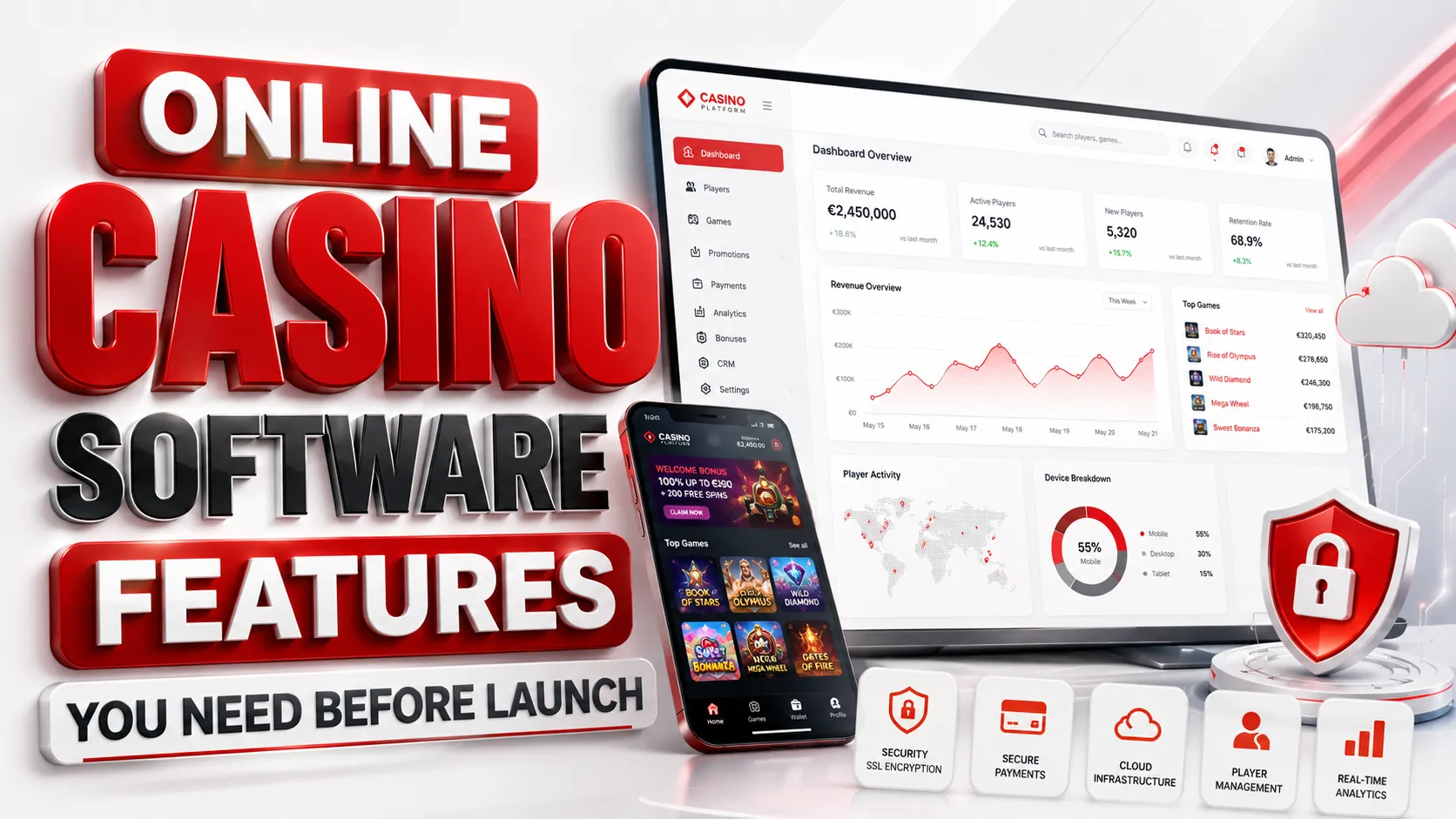
Which Features Should You Prioritize Before Launching an Online Casino?
The online gambling space is growing fast, and that means real opportunities for entrepreneurs, casino operators, and tech companies. But launching a successful online casino isn’t just about grabbing a license and plugging in a few games. The real foundation is choosing the right online casino software and building in the features that actually matter to players - security, smooth gameplay, fast payments, and a platform that feels effortless.

Whether you’re aiming for the UK, Malta, Curaçao, UAE, Ontario, New Jersey, or Brazil, the technology decisions you make before launch will shape how well the business performs long-term.
This guide covers the key features operators, founders, and CTOs should focus on when choosing an online casino platform.
Why the Right Software Actually Matters
Your casino platform is the backbone of everything. Player registration, payments, game management, security, compliance, marketing, support, analytics - it all runs through the software.
A solid platform lets you handle:
- Player accounts
- Casino games
- Payments
- Security
- Compliance
- Marketing campaigns
- Customer support
- Business analytics
When the software is strong, you can focus on growing the business instead of constantly putting out fires. Players also get a professional, reliable experience.
Poor software, on the other hand, usually leads to:
- Slow performance
- Payment problems
- Security gaps
- Weak retention
- Compliance headaches
- Limited ability to scale
That’s why software choice should be one of the first and most important decisions you make.
1. A Strong and Varied Game Library
The first thing most players notice is the game selection. A thin library makes it hard to compete with established brands and usually means shorter sessions.
A good platform should give you access to a wide range of games, including:
- Video slots
- Classic slots
- Progressive jackpots
- Live dealer games
- Blackjack
- Roulette
- Baccarat
- Poker
- Crash games
- Instant-win games
- Virtual sports
A diverse catalog helps you attract different player types and keeps people playing longer.
Why multiple game providers matter Working with several studios gives you more flexibility and variety. Popular providers in the industry include Evolution, Pragmatic Play, Playtech, NetEnt, Microgaming, Relax Gaming, BGaming, and Hacksaw Gaming.
Strong software should make it easy to integrate multiple providers through APIs or aggregators. The benefits are clear:
- Faster game launches
- More options for players
- Better retention
- Stronger competitive position
2. Mobile-First Experience
Mobile is now one of the biggest drivers of online casino growth. A large share of players prefer phones over desktops, so mobile performance isn’t optional anymore - it’s essential.
A proper mobile-friendly platform needs:
- Responsive design
- Fast loading
- Touch-friendly navigation
- Solid Android and iOS support
- Games that work well on small screens
- Easy account management
- Smooth payment flows
A weak mobile experience usually means higher bounce rates and lost revenue.
Players expect quick registration, instant deposits, smooth gameplay, easy withdrawals, and simple navigation. Markets like the UK, Ontario, New Jersey, and Brazil are especially mobile-heavy, so this is non-negotiable if you’re targeting those regions.
3. Flexible and Secure Payment Options
Payment experience directly affects trust and conversion. Players stick with casinos that make depositing and withdrawing feel easy and familiar.
A modern platform should support a range of methods suited to your target markets:
- Credit and debit cards
- Bank transfers
- E-wallets
- Cryptocurrency (where allowed)
- Local payment solutions
It also needs to handle:
- Fast deposits
- Quick withdrawals
- Multi-currency support
- Fraud prevention
- Transaction monitoring
- Secure processing
Payment flexibility improves the player experience. UK players often prefer cards and e-wallets, Brazilian players look for local options, and international players may want crypto where it’s available. Matching those preferences helps with satisfaction and retention.
4. Serious Security Infrastructure
Players hand over personal and financial information, so security has to be solid. A reliable platform should include:
- SSL encryption
- Two-factor authentication
- DDoS protection
- PCI DSS compliance
- Firewall protection
- Data encryption
- Fraud detection
- Secure API connections
Online casinos face real risks - account takeovers, payment fraud, identity theft, bonus abuse, and cyber attacks. Strong security protects both players and the operator while helping meet regulatory expectations.

5. Built-in Compliance Tools
Running a licensed casino means dealing with strict local rules. Different jurisdictions have different requirements, so compliance features need to be part of the software from day one.
Key tools include:
- KYC (Know Your Customer)
- AML (Anti-Money Laundering)
- Age verification
- Player verification
- Transaction monitoring
- Audit reports
- Responsible gambling controls
If you’re entering markets such as the UK, Malta, Curaçao, Ontario, New Jersey, or Brazil, your technology has to support the local standards. Having these tools built in reduces operational complexity and lowers the risk of legal problems after launch.
6. CRM and Player Management
Acquiring new players is important, but keeping existing ones is what actually drives long-term profit. That’s why a strong CRM system is one of the most valuable features to have in place before you launch.
A good casino CRM helps you understand how players behave, deliver more relevant experiences, and build loyalty over time.
Useful CRM capabilities include:
- Player segmentation
- Detailed customer profiles
- VIP management
- Loyalty programs
- Personalized promotions
- Automated messaging
- Email marketing
- SMS campaigns
- Push notifications
- Activity tracking
Not every player is the same. Some prefer slots, others stick to live dealer or table games. With solid CRM tools, you can recommend the right games, send targeted offers, spot high-value players early, improve retention, and increase lifetime value.
In competitive markets like the UK, Malta, Ontario, New Jersey, and Brazil, personalization can become a real edge.
7. Flexible Bonus and Promotion Engine
Bonuses remain one of the most effective ways to attract new players and keep them coming back. But managing promotions manually gets messy quickly as the casino grows. That’s why a flexible bonus engine is essential.
A strong system should support:
- Welcome bonuses
- Deposit bonuses
- Free spins
- Cashback
- Reload offers
- Referral rewards
- VIP rewards
- Seasonal campaigns
- Tournaments
Automation makes a big difference. You can launch promotions faster, set clear wagering requirements, control who is eligible, reduce bonus abuse, and track performance properly. You can also run different offers for new players, regulars, and VIPs without disrupting day-to-day operations.
8. Responsible Gambling Tools
Responsible gambling is no longer optional in regulated markets. Operators are expected to give players real tools to stay in control and protect those who may be at risk.
Key features include:
- Deposit limits
- Loss limits
- Session time limits
- Reality checks
- Self-exclusion
- Cooling-off periods
- Gambling history reports
Regulators in places like the UK, Malta, Ontario, and New Jersey require these measures. Beyond compliance, they help build trust, reduce harm, and protect your brand’s reputation. A platform without proper responsible gambling tools is asking for both regulatory and reputational problems.
9. Real-Time Analytics and Reporting
Data is central to running a modern casino. You need clear, accurate insights to make good decisions.
A solid analytics dashboard should show:
- Active players
- Revenue performance
- Gross Gaming Revenue (GGR)
- Net Gaming Revenue (NGR)
- Deposit activity
- Withdrawal trends
- Retention metrics
- Game performance
- Marketing results
- Conversion rates
Real-time data helps you see which games actually make money, which promotions work, where players drop off, and which markets deliver the most value. That information lets you refine marketing, improve the experience, and grow profit more deliberately.
10. Multi-Language and Multi-Currency Support
If international expansion is part of the plan, localization needs to be built in from the start. Players respond better to platforms that feel familiar.
A multi-market casino should support:
- Multiple languages
- Local currencies
- Regional payment methods
- Localized promotions
- Market-specific content
For example, UK players expect GBP and familiar payment options. Brazilian players prefer Portuguese. UAE audiences may need Arabic. Many European markets require several language options. Getting localization right improves trust, engagement, and conversion.
11. Seamless Third-Party Integrations
A scalable platform should connect easily with external tools and services. An API-first approach lets you add new solutions without rebuilding everything.
Important integrations typically include:
- Game providers
- Payment gateways
- KYC providers
- AML solutions
- CRM systems
- Affiliate platforms
- Marketing automation
- Fraud detection
- Customer support tools
As the business grows, your needs will change. Flexible integrations make it easier to add payment methods, expand the game library, strengthen security, enter new markets, or upgrade systems. Future-proof platforms are designed for continuous improvement.
12. Affiliate Management System
Affiliate marketing is still one of the strongest acquisition channels in iGaming. A dedicated affiliate system helps you manage partnerships and track results clearly.
Essential features include:
- Affiliate registration
- Tracking links
- Commission management
- Real-time reporting
- Revenue share calculations
- Marketing materials
- Fraud monitoring
A good affiliate setup increases visibility, brings more targeted traffic, lowers acquisition costs, and supports longer-term partnerships. For new brands entering competitive markets, strong affiliate networks can meaningfully speed up growth.
13. Customer Support Tools
Good support is one of the clearest ways to stand out. Players expect quick help when something goes wrong with payments, verification, bonuses, technical issues, or games.
A complete platform should offer:
- Live chat
- Email ticketing
- AI chatbots
- Help center
- FAQs
- Knowledge base
Fast, effective resolution builds confidence. Players who get proper support are more likely to stay and recommend the brand to others.
14. Scalable Cloud Infrastructure
Think about growth from day one. A platform that handles a few thousand players can struggle when traffic jumps.
Solid scalable infrastructure usually includes:
- Cloud hosting
- Load balancing
- High availability
- Automatic scaling
- Data backups
- Disaster recovery
Cloud-based systems generally deliver better performance, higher reliability, faster updates, less maintenance overhead, and easier expansion into new markets. Ambitious operators treat scalability as a launch priority, not a later upgrade.
15. AI and Personalization
AI is already changing how online casinos operate - both for players and for the business behind the scenes.
Modern platforms can use AI for:
- Personalized game recommendations
- Fraud detection
- Player behavior analysis
- Automated support
- Responsible gambling monitoring
- Marketing optimization
In practice, this means suggesting games based on past activity, flagging unusual account behavior, creating more relevant offers, and predicting engagement patterns. As competition intensifies, AI-driven features can become a meaningful advantage.
Common Mistakes to Avoid Before Launching an Online Casino
Launching an online casino takes careful planning, solid technical choices, and a real understanding of the iGaming market. Too many new operators rush to get games live and go live fast — only to discover later that they skipped critical pieces. Those gaps can create serious problems down the line.
Here are some of the most common mistakes to avoid:
1. Choosing software only because it’s cheap One of the biggest early errors is picking the lowest-priced platform without looking at what it can actually do long-term. Cheap solutions often fall short on security, scalability, compliance tools, reporting, support quality, and integration flexibility.
Initial cost matters, but overall value matters more. A more capable platform may cost more upfront, yet it usually delivers better performance, stronger security, and more room to grow.
2. Ignoring regulatory requirements Every market has its own rules. Launching without properly accounting for them can lead to licensing problems, fines, operational limits, or a loss of player trust.
If you’re targeting the UK, Malta, Curaçao, Ontario, New Jersey, Brazil, or similar jurisdictions, make sure the platform supports the local standards - especially KYC, AML monitoring, responsible gambling tools, player protection, and required reporting.
3. Neglecting mobile optimization A site that works well only on desktop will lose a large share of potential players. Before launch, thoroughly test mobile loading speed, navigation, payments, game compatibility, and account management. A genuine mobile-first approach is no longer optional.
4. Offering limited payment options Payment friction is one of the top reasons players leave. Provide multiple methods, fast deposits, secure processing, reasonably quick withdrawals, and local options where they matter. Flexible payments build trust and improve conversion.
5. Treating security as secondary Security is not an optional add-on. Weak protection leaves the business exposed to data breaches, fraud, account takeovers, and financial losses. Invest in encryption, fraud prevention, secure authentication, and regular testing. A secure platform protects both the operator and the players.
6. Focusing only on acquisition and ignoring retention Many operators pour energy into getting new players while underinvesting in keeping them. Successful casinos use loyalty programs, VIP systems, personalized offers, CRM automation, and ongoing engagement campaigns. Retaining existing players is almost always more cost-effective than constantly chasing new ones.
Final Thoughts: Building a Platform That Can Last
Launching an online casino is about more than adding games and putting up a website. Long-term success depends heavily on choosing the right software and implementing the right features from the start.
The priorities that matter most include:
- Broad and quality game selection
- Mobile-first design
- Secure and flexible payments
- Strong security infrastructure
- Built-in compliance tools
- Effective CRM and player management
- Flexible bonus systems
- Responsible gambling features
- Clear analytics and reporting
- Multi-language and multi-currency support
- Easy third-party integrations
- Affiliate management
- Scalable infrastructure
- AI-driven personalization where it adds real value
Whether you’re launching in the UK, Malta, Curaçao, UAE, Ontario, New Jersey, Brazil, or elsewhere, a solid technology foundation makes it far easier to deliver a competitive player experience, stay compliant, run operations efficiently, and prepare for growth.

The platform you choose today becomes the backbone of the brand you build tomorrow.
Frequently Asked Questions
1. What is online casino software? It’s the core technology that runs an online casino. It handles games, player accounts, payments, security, bonuses, compliance, reporting, and most of the day-to-day operations.
2. Which features should be prioritized before launch? Focus first on game integration, mobile optimization, payment solutions, security, compliance tools, CRM, analytics, and responsible gambling features. These form the foundation of a secure and usable casino experience.
3. Why does mobile compatibility matter so much? Most players now access casinos on smartphones. A well-optimized mobile experience improves engagement, conversion, and retention.
4. How does CRM help casino operators? CRM tools help you understand player behavior and deliver more relevant experiences through targeted promotions, loyalty programs, VIP management, and automated communication. This supports better retention and higher lifetime value.
5. What payment methods should an online casino offer? A modern casino should support cards, bank transfers, e-wallets, cryptocurrency where allowed, and local payment methods that match the preferences of the target market.
6. Why are responsible gambling features important? They help protect players and meet regulatory requirements. Common tools include deposit limits, self-exclusion, session reminders, and other player-protection controls. These are expected in regulated markets.
7. How important is security in casino software? Extremely important. Strong security protects player data, financial transactions, and the business itself. Key measures include encryption, fraud detection, and secure authentication.
8. Can casino software support multiple countries? Yes. Advanced platforms support multiple languages, currencies, regional payment methods, and market-specific compliance tools, making international expansion more practical.
9. How does AI improve online casino operations? AI can power personalized recommendations, improve fraud detection, automate parts of customer support, analyze player behavior, and assist with responsible gambling monitoring. Used well, it can raise both efficiency and player satisfaction.
10. What should operators look for when choosing casino software? Evaluate security, scalability, compliance support, game integrations, payment flexibility, CRM capabilities, analytics, and the quality of technical support. Choosing the right technology partner is one of the most important decisions you’ll make before launch.
